
Introduction
Most websites from 1999 are digital ghosts. You find them in archives, frozen in time. But type Knuddels.de into your browser today and it loads. A list of chat rooms pops up, showing active user counts. People are in there right now, talking. It feels like finding a payphone that still works—a functional relic from a different era of communication. This isn’t a museum exhibit. It’s a living, active community. The question isn’t just how it survived, but what it offers that the modern internet has forgotten.
A Brief History of Knuddels
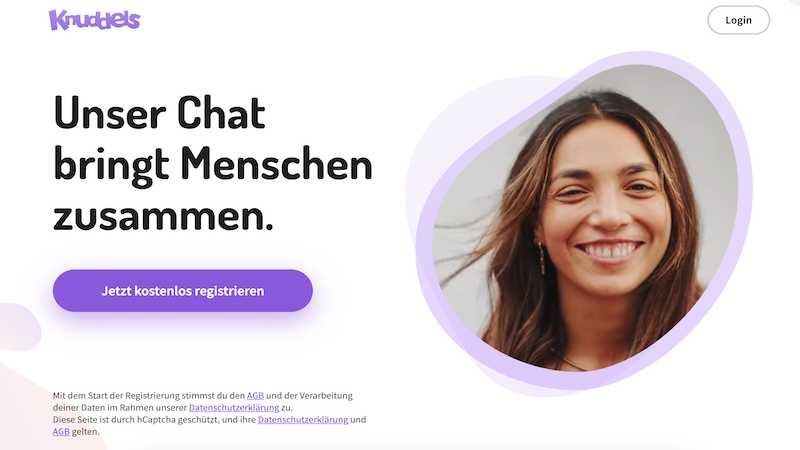
Knuddels chat launched in 1999. For context, that was the year Napster peaked and people feared the Y2K bug. Its design philosophy was straightforward: create dedicated spaces for conversation and add games to make talking easier. Twenty-five years later, that same blueprint is still running.
It was a central, organic community in the landscape of the early social web.
As the internet pivoted towards algorithmic feeds and curated profiles, Knuddels chat made a defining choice. It added mobile apps for modern access but fundamentally held its ground. The core experience—thematic rooms, text-based chat, integrated games—remained untouched. No news feed, no stories, no recommendation engine.
This resistance to change became its identity. While other platforms evolved into attention engines, Knuddels remained a user-controlled German chat platform. Its value lies in its predictability. In a digital economy built on surprise, it offers the quiet reliability of a space that operates on its own, unchanged terms.
What You Actually Get With Knuddels
Forget calling it a “social network.” That’s too broad. Knuddels is a very specific machine built for two things: typed conversation and casual games. It doesn’t do video calls. It doesn’t have stories or reels. Its most modern feature might be the Knuddels app. The magic is in how these pieces lock together.
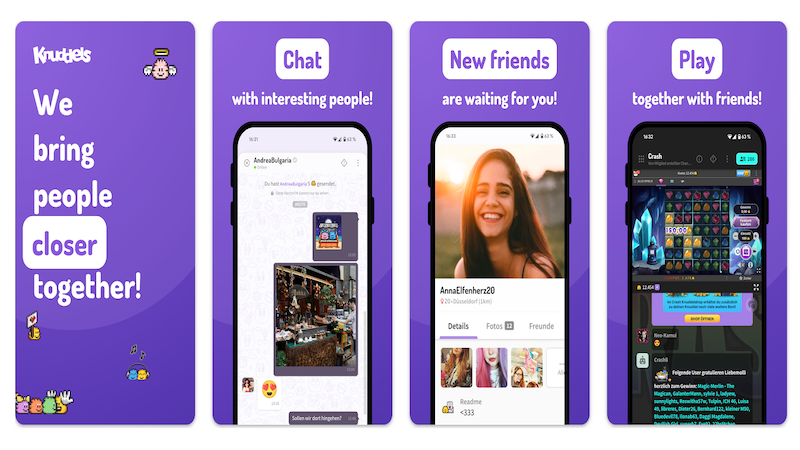
Chat Rooms with a Purpose
You don’t enter a void. The platform is a grid of themed rooms. There’s a room for people from Stuttgart. A room for heavy metal fans. A room for chess players and a room for flirting. This structure is the entire foundation. It solves the core anxiety of online chat—”what do I say?”—by giving you the topic in advance. You join the “90s Music” room because you remember the songs. The shared interest is already established. These rooms become digital constants. Regulars log in daily to the same few rooms, creating a sense of place that ephemeral group chats can’t match.
Games as Social Tools
The platform hosts over 100 basic, browser-based games. Card games like Skat and Mau-Mau. Dice games. Simple puzzles. They aren’t graphically impressive. Their value is social, not technical. In a chat room, you can challenge someone to a game with two clicks. The game becomes the conversation. It gives you something to do while you talk, a shared activity that doesn’t require intense focus. For many, Knuddels is primarily a free games community where the chatter happens naturally between moves.
Identity Built on a Nickname
Your profile is not a portfolio. It’s a username you chose, perhaps years ago. There’s no emphasis on photos or life updates. Your reputation is your chat history, your game scores, and your presence in your regular rooms. Relationships form through typed words and shared games over time, not through curated self-presentation.
How to Get Started with Knuddels
Using Knuddels is deliberately straightforward. There’s no learning curve.
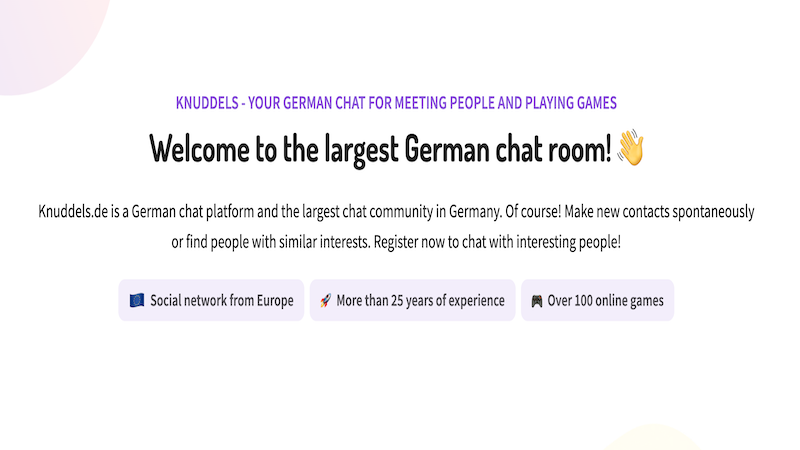
1. Go to the site or get the app. Head to knuddels.de on a computer, or download the official Knuddels app. The experience is nearly identical.
2. Pick a name and register. Your username is permanent. Choose wisely—it’s how you’ll be known. Your Knuddels login will be your key to gaining access to the community.
3. Don’t just stare at the list—pick a room. The sidebar shows all active rooms. Ignore the user count and find a topic that genuinely interests you. Click join.
4. Lurk, then speak. Watch the conversation flow for a few minutes. Get the vibe. Then, jump in. Use one of their thousands of custom emoticons to express tone. It’s okay to say you’re new.
5. Use a game as your introduction. If conversation is slow, challenge someone to a simple dice or card game. It’s the most natural social mechanic on the platform.
Who Are Suitable for Knuddels?
This isn’t a platform for everyone. It serves a specific niche brilliantly.
-
German Speakers, Period. This is the absolute rule. The entire ecosystem—jokes, room topics, support—operates in Germany. It’s a language-based fortress. A tourist without the language will be utterly lost.
-
People Who Prefer Typing. If you find video chat exhausting and enjoy the craft of writing a clever message, this is your arena. Relationships here build slowly, through text.
-
Community Seekers, Not Daters. While flirtation exists, many users are there for the long-term, low-stakes camaraderie of a recurring group. It’s about the regulars in the “Berlin Evening” room, not a one-time match.
-
Casual Gamers Who Chat. If your idea of fun is playing three rounds of Skat while arguing about football with your opponent, this combination is uniquely served here.
FAQs
Is Knuddels actually free?
Yes. Completely. It has always been free to sign up, chat, and play the vast majority of games. This is a major reason for its longevity and accessibility.
What’s a good first game to try?
Start simple and social. “Photo Meet” lets you browse profiles casually. “Mau-Mau” is an easy-to-learn card game. Avoid complex classics like Skat at first unless you already know the rules. The various dice games are perfect for quick, low-commitment fun.
Is Knuddels safe for teenagers to use?
Let’s be real—it’s an open chat room. They do have moderators and basic rules, which already makes it better than those completely lawless random chat sites. The themed rooms often develop their own vibe, where regulars keep a kind of informal watchfulness.
For any teen logging on, a few hard rules are non-negotiable:
-
Your name should be made up. Pick a nickname you like—that’s your identity here. Your real name stays offline.
-
Personal information is not allowed at all. Never mention your school, the street you live on, or the cafe you frequent after class—anything that identifies your location—no matter how pleasant the conversation grows.
-
Don’t hesitate to block someone. If a conversation feels weird or someone pressures you, hit the block button first. The report feature is right there and just use it.
I don’t speak German. Is there any point?
Frankly, no. You can physically create an account, but you won’t be able to participate. Language is the product. It’s like walking into a local club where everyone is speaking a language you don’t understand.
Why are knuddels still popular today?
Because it offers something modern platforms abandoned: consistency and user control. Your experience isn’t shaped by a secret algorithm. You choose a room. You choose to play a game. The interface doesn’t change every six months. In a chaotic online world, Knuddels is a fixed, predictable point. It didn’t adapt to the modern internet; it remained a pocket of the old one, and for its users, that’s the whole appeal. It’s less a website and more a preserved digital habitat.
What are some Knuddels alternatives?
If live video conversations are more your style, 1v1 Video Call offers a modern space centered around one-on-one video chat. For those drawn to the dynamics of live streaming and virtual communities, Camloo builds its experience around broadcasters and audience interaction. And if you’re purely after the classic, unpredictable thrill of meeting a random stranger online, Bumble delivers that specific, straightforward experience.